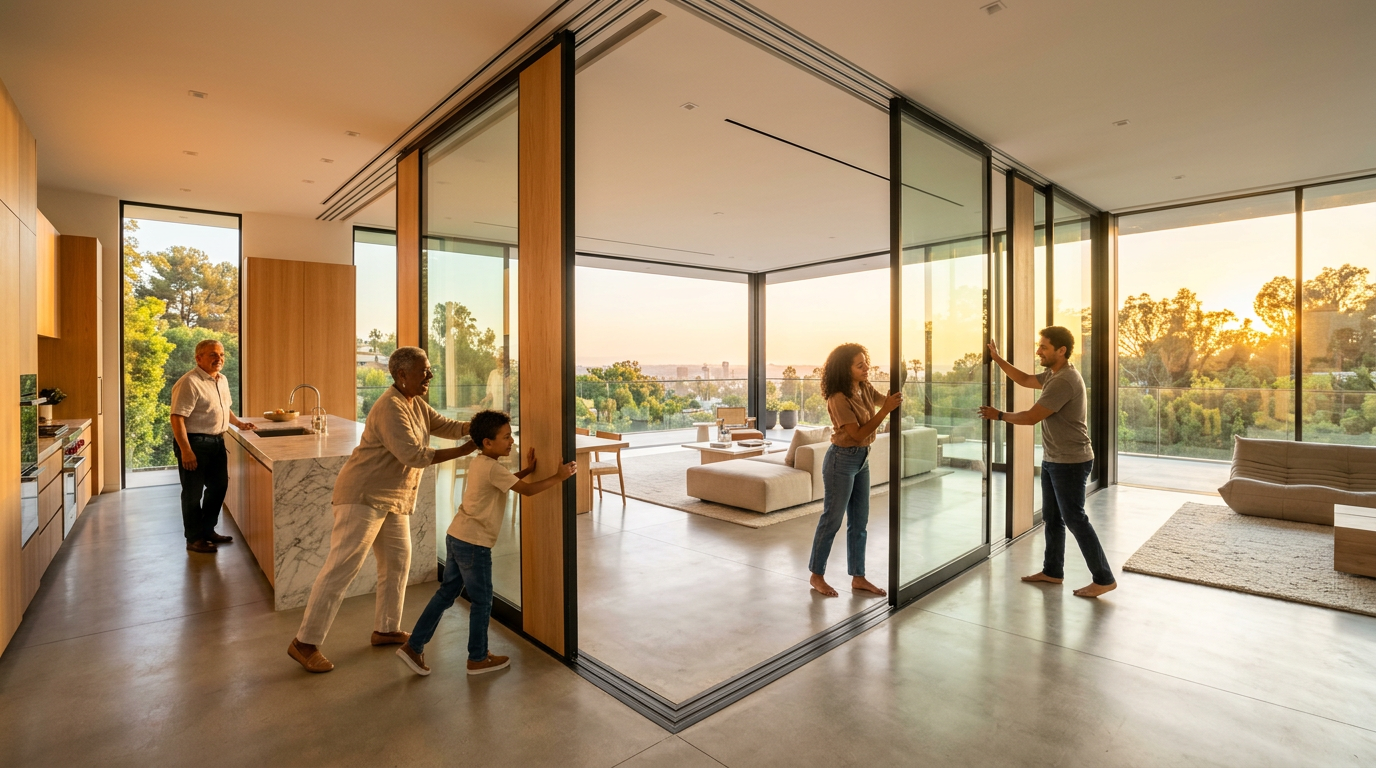
In the upper tiers of the luxury market, the traditional approach to residential design has long been rooted in the concept of permanence. Owners frequently commission architects to create static monuments to their current lifestyle, assuming that the physical walls of a property will forever serve the same functions as the day they were completed. However, the most sophisticated portfolios now view the luxury estate through a lens of kinetic adaptability. True value in the $10M+ sector is increasingly tethered to a property's capacity to evolve alongside the changing demographics and requirements of a multi-generational family.
The transition from static architecture to kinetic design requires a departure from rigid floor plans. We are observing a significant movement toward modular interior envelopes that allow for the seamless reconfiguration of space. This is not a matter of moving furniture, but a fundamental rethinking of structural systems. When a primary suite can be integrated into a larger guest wing, or a professional-grade home office can be partitioned into a private educational suite without compromising the envelope of the home, the asset gains a secondary layer of liquidity. It ensures that the residence remains an active participant in the owner's life rather than a static box that eventually necessitates either costly renovation or divestment.
Structural flexibility is the new hedge against market obsolescence. High-net-worth individuals often find themselves trapped by a property that was perfectly suited for a young family but fails to serve the needs of a household with aging parents, adult children returning for extended stays, or the integration of professional staff. When the structural bones of a house are rigid, the cost of adaptation often exceeds the cost of acquisition. Forward-thinking owners are now demanding mechanical, electrical, and plumbing systems that are centralized and accessible, allowing for modifications to internal walls and utilities with minimal disruption to the exterior architecture. This approach respects the legacy of the original design while acknowledging the inevitable passage of time.
Beyond the internal mechanics, the kinetic estate addresses the psychological needs of its inhabitants by curating spaces that serve as soft buffers between generations. The modern family unit often operates as a decentralized entity, with members requiring both proximity and total independence. Designers who understand this are moving away from the cavernous open-plan living areas that defined the previous decade. Instead, they are prioritizing the creation of flexible nodes that can function as communal gathering points or isolated private retreats depending on the rhythm of the household. This nuance in spatial arrangement is what separates a mere house from an enduring family headquarters.
The integration of smart infrastructure is equally critical to this longevity. Beyond the standard automated lighting or climate control, the truly sophisticated estate utilizes a robust digital architecture that can be upgraded without the need for invasive retrofitting. By embedding high-capacity conduits and centralized server hubs into the foundation of the build, the property remains relevant as technology shifts. This future-proofing is a form of capital preservation. When an estate is designed with the assumption of technological evolution, the owner avoids the dreaded cycle of obsolescence that plagues so many modern luxury assets.
Ultimately, the value of a property is determined by its utility over a forty-year horizon rather than its aesthetic impact at the moment of completion. Investors who view their residences as living assets are finding that properties with high degrees of adaptability command a significant premium upon exit. Buyers in this market are no longer just purchasing a physical structure; they are purchasing a platform for their family's future. By investing in modularity, structural foresight, and technological readiness, owners ensure that their estate remains a source of utility rather than a source of maintenance. The goal is to create a home that is as intellectually agile as the people who reside within it, capable of absorbing the complex, shifting demands of a successful life without ever losing its fundamental grace.