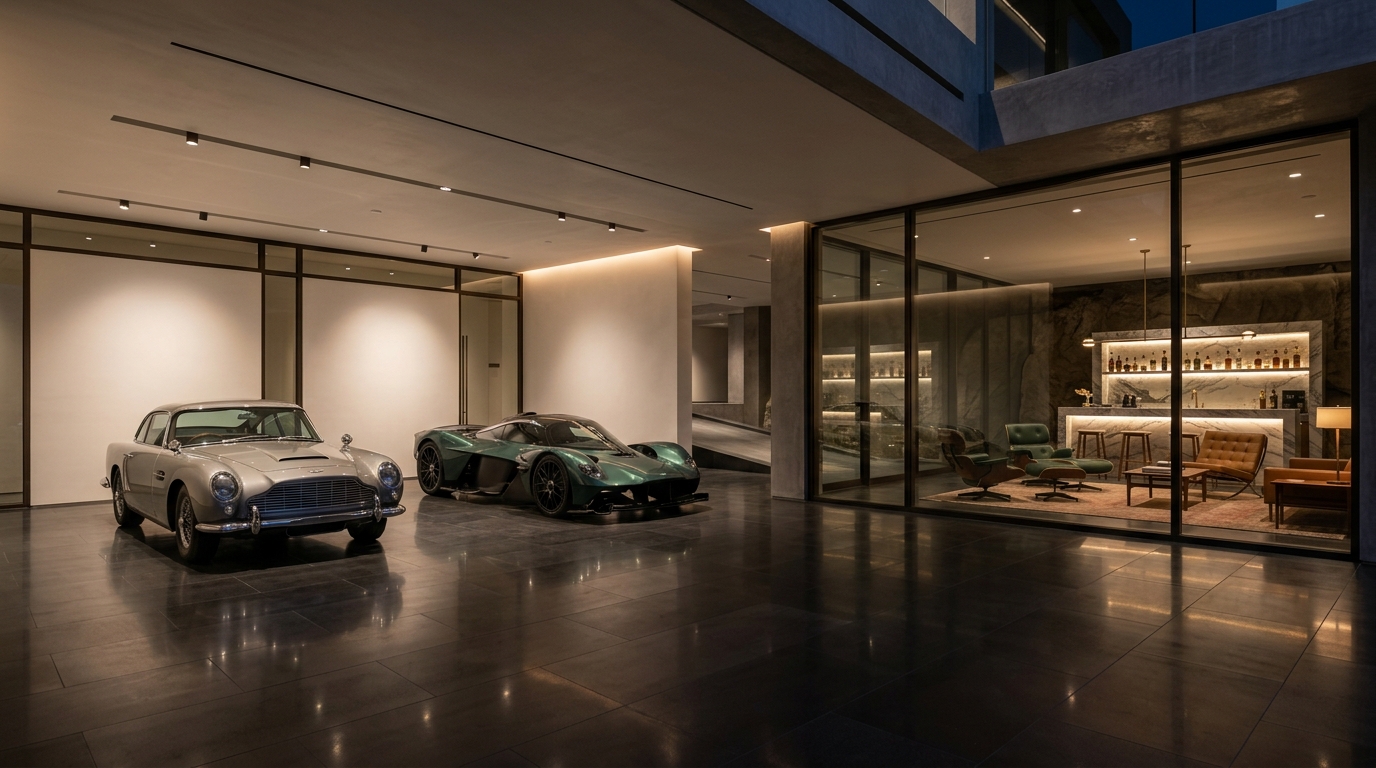
In the upper reaches of the West Coast residential market, the traditional three-car garage has become a relic of suburban utility. For the ultra-high-net-worth individual, the vehicle is no longer merely a tool for transit but a curated asset requiring an architectural environment that reflects its capital value. In neighborhoods such as Bel Air, Beverly Hills, and Holmby Hills, we are observing a significant shift toward the integration of museum-grade automotive galleries into the primary residential structure. These are not merely storage spaces: they are sophisticated, climate-controlled environments designed for both preservation and social exhibition.
The distinction between a high-end garage and an architectural gallery lies in the technical specifications. Institutional-quality galleries require specialized HVAC systems capable of maintaining constant humidity and temperature levels to preserve carbon fiber, vintage leather, and sensitive engine components. Standard residential systems are often insufficient for the off-gassing associated with internal combustion engines, necessitating industrial-grade ventilation that operates silently. These systems must be integrated into the home's primary mechanical core without compromising the acoustic integrity of the living spaces above.
Engineering for these spaces often requires significant subterranean excavation, particularly in hillside properties where horizontal land is at a premium. The structural requirements for high-density vehicle storage involve reinforced concrete slabs designed to withstand the point-loading of heavy luxury vehicles and hydraulic lift systems. When a property features a glass-walled gallery visible from the main living area, the architectural challenge is to balance the industrial nature of the space with the refined finishes of the residence. This often involves the use of structural glass partitions that meet rigorous fire-safety codes while remaining visually unobtrusive.
From a valuation perspective, these galleries represent a unique category of square footage. While traditional appraisers may historically discount non-living areas, a professionally engineered automotive gallery can bridge the gap between utility and finished space. In the tier exceeding twenty million dollars, a property lacking a sophisticated display environment for a collection may face a narrower buyer pool and extended days on market. The capital expenditure required for these installations is often recaptured through the increased desirability of the estate to international collectors who view their vehicles as a core component of their wealth portfolio.
Lighting is perhaps the most critical component of the automotive gallery. Architects are moving away from overhead fluorescent fixtures in favor of high Color Rendering Index (CRI) LEDs and programmable tracks that highlight the sculptural lines of the vehicles without creating glare on metallic or matte finishes. Materials such as epoxy-poured floors, polished basalt, or large-format porcelain tiles provide the necessary durability to withstand tire marks and fluid leaks while maintaining the aesthetic continuity of the home. The goal is to create a space that feels like an extension of the gallery or library, rather than a service area.
The modern automotive gallery also serves as a social hub. We are observing a trend where bars, lounge seating, and media installations are integrated directly into the display space. This transforms the area from a passive storage zone into an active entertainment venue. It reflects a broader movement toward hobby-centric architecture, where the home is designed around the specific passions of the owner, rather than a generic template of luxury. In the Platinum Triangle, where privacy is the ultimate commodity, having a private venue to host fellow collectors among one's assets is a powerful social and financial lubricant.
Furthermore, subterranean galleries allow owners to maximize their buildable square footage in municipalities with strict Floor Area Ratio (FAR) and height restrictions. By moving the automotive component underground, architects can dedicate more of the visible building envelope to primary living quarters and views. This strategic use of the site's verticality ensures that the property remains competitive in a market where every square foot of land must be optimized for its highest and best use. As the market for blue-chip collector cars continues to expand, the architecture that houses them will remain a primary driver of estate value. For the sophisticated investor, the inclusion of a museum-grade gallery is not an indulgence but a strategic enhancement of the property's utility and long-term marketability.