In the rarefied air of the Lake Washington luxury market, the traditional metric of price per square foot frequently fails to explain the profound valuation gaps between adjacent properties. While superficial finishes and architectural pedigree draw initial attention, the true determinant of an asset's long term performance is its precise orientation relative to the water. Discerning investors have begun to treat shoreline exposure not as a static feature, but as a dynamic financial instrument that dictates both liquidity and capital preservation.
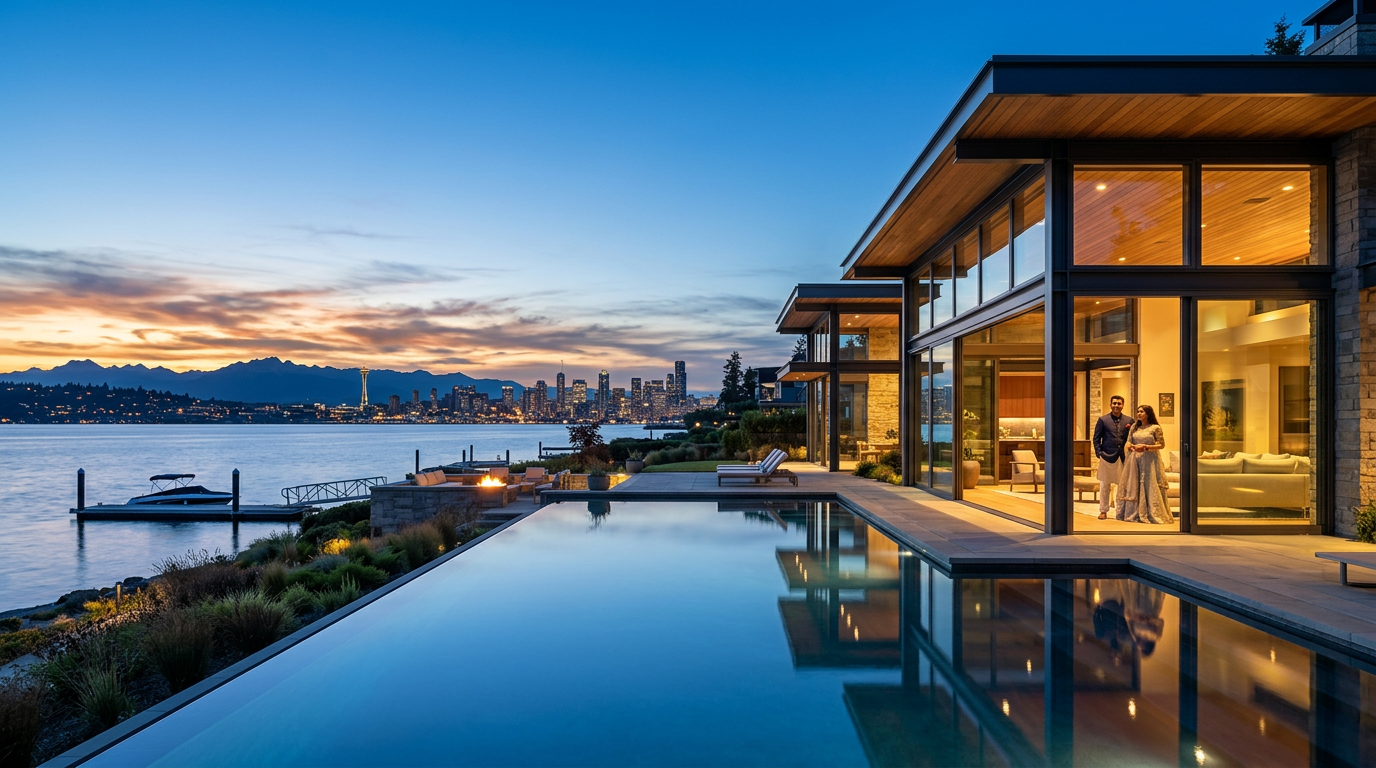
The orientation of a parcel toward the western or southwestern sky is the primary variable in what seasoned brokers refer to as the solar premium. Properties facing the setting sun command a disproportionate share of total market demand, primarily because they capture the rare, high-intensity light that characterizes the Pacific Northwest's peak summer months. This is not merely a matter of aesthetic preference. A western-facing orientation extends the functional utility of exterior spaces, effectively increasing the usable square footage of the property during the most desirable times of the day. In a market where outdoor living is constrained by climate, the ability to extend one's interaction with natural light is a tangible commodity that institutional buyers price with precision.
Shoreline geometry functions as a silent anchor for asset stability. Assets situated on deep-water coves or protected bays offer a level of privacy and protection from the elements that open-water frontage often lacks. While open-water views provide a sense of grand scale, they also introduce significant exposure to prevailing winds and the erosive impact of heavy wave action. Investors with a focus on generational wealth are increasingly favoring parcels with subtle indentations in the topography, as these features naturally shield the primary structure from seasonal volatility. This protective quality translates directly into lower maintenance overheads and a reduced risk of structural degradation, factors that become highly visible during the due diligence phase of an acquisition.
Furthermore, the depth of the water at the bulkhead represents a critical barrier to entry that insulates established estates from encroachment. Properties that accommodate deep-draft vessels without the need for extensive, high-maintenance dock extensions hold an inherent advantage in the marketplace. As local regulatory environments become increasingly stringent regarding the footprint of over-water structures, the existing entitlement to a deep-water dock acts as a form of restricted supply. Owners of these specific assets possess a competitive moat, as the cost and logistical complexity of replicating such a feature for a new entrant are often prohibitive, if not entirely impossible under current codes.
The interaction between shoreline length and interior floor plan alignment is a frequently overlooked driver of value. The most sophisticated estates are those where the internal circulation of the residence is explicitly mapped to the water. When the primary living corridors are oriented to maximize the transition between internal and external environments, the property achieves a higher degree of transactional velocity. Properties that force a disconnect between the interior program and the water's edge often struggle to achieve the same price discovery as those where the architectural narrative is subservient to the lake itself. We observe that liquidity is highest in homes where the sightlines are unobstructed and the transition to the water is seamless, effectively treating the lake as an extension of the internal living space.
Investors must also account for the influence of prevailing wind patterns on the year-round habitability of the shoreline. A parcel that sits on the leeward side of a promontory may offer superior comfort compared to a more exposed frontage, regardless of the view quality. The market eventually corrects for these micro-environmental factors, often punishing properties that suffer from excessive wind exposure by extending their days on market. Discerning capital prioritizes these nuanced environmental advantages, recognizing that the long-term desirability of a residential asset is anchored to its ability to provide a consistent, high-quality experience across all four seasons. By focusing on the intersection of orientation, shoreline protection, and navigational depth, investors can identify the assets that will retain their premium standing regardless of broader macroeconomic shifts.