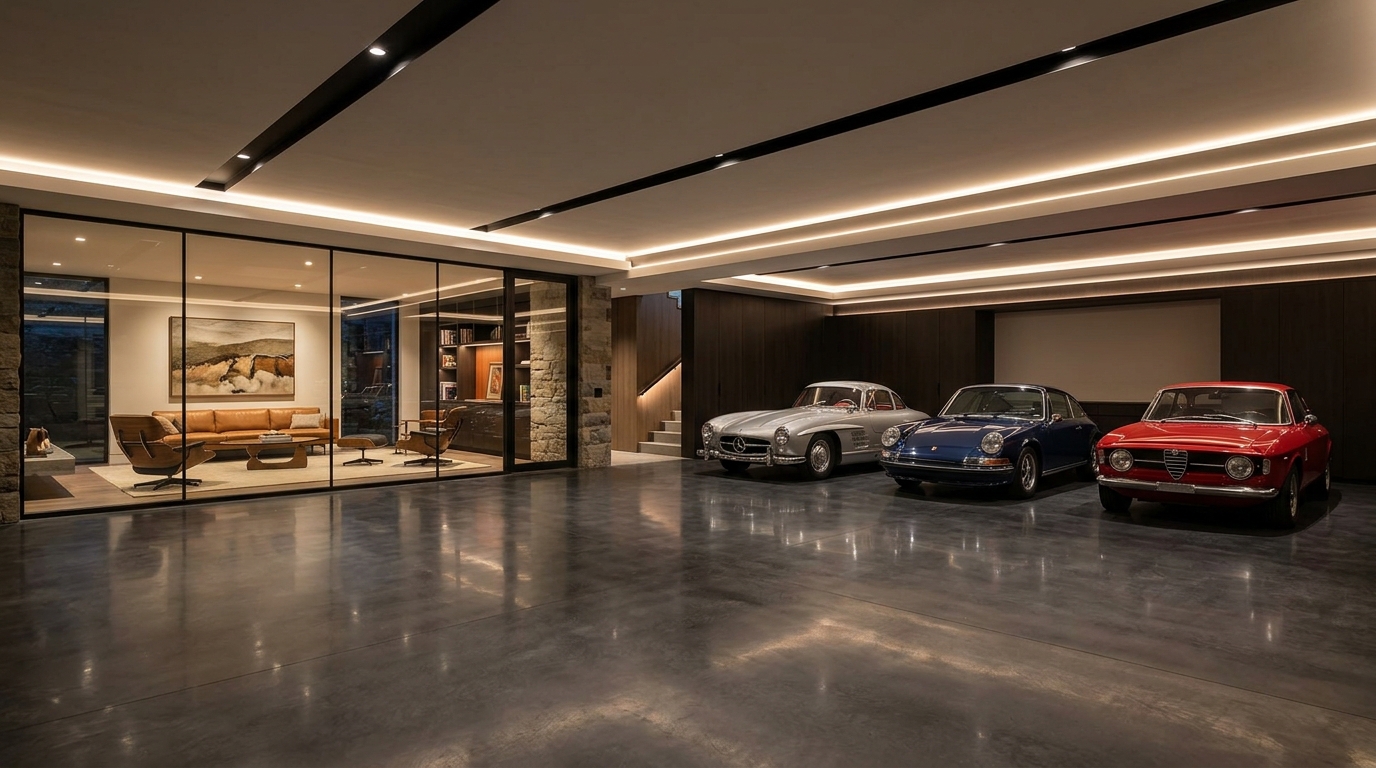
In the ultra-prime corridors of Beverly Hills, Bel Air, and Holmby Hills, the traditional multi-car garage has undergone a fundamental transformation. No longer relegated to a utilitarian annex, the storage of high-value automotive assets is being integrated into the core architectural program of the modern estate. This shift is driven by a sophisticated class of collectors who view their vehicles not merely as transport, but as a significant component of their alternative asset portfolio. Consequently, the presence of a subterranean automotive vault, engineered to museum standards, now commands a distinct premium that often exceeds the cost of its own construction.
For the high-net-worth individual, the motivation to bring a collection on-site is rooted in both security and accessibility. While off-site facilities in industrial hubs offer professional management, they lack the immediate proximity required for the spontaneous enjoyment of the asset. The current market trend favors the internalization of these collections, necessitating a level of structural engineering that was once reserved for commercial infrastructure. In the hillside enclaves of the West Coast, where buildable land is finite and strictly regulated, the only direction for expansion is downward. Excavating into the bedrock of a Bel Air hillside to create a climate-controlled gallery is a capital-intensive endeavor, yet the market is increasingly rewarding this foresight with valuations that reflect the rarity of such permitted space.
The technical specifications of these vaults are rigorous. Unlike standard residential garages, subterranean galleries require advanced HVAC systems capable of maintaining precise humidity levels and constant temperatures to prevent the degradation of leather, rubber, and delicate electronics. Furthermore, the integration of industrial-grade fire suppression systems, such as Novec 1230 fluid, is a prerequisite for protecting multimillion-dollar portfolios without the risk of water damage associated with traditional sprinklers. These systems, while invisible to the casual observer, are critical data points for the sophisticated buyer who understands the operational overhead of a world-class collection.
Valuation in the $20 million plus tier is increasingly sensitive to what we call ancillary utility. When an estate offers a subterranean vault with a hydraulic car lift or a turntable, it effectively removes the friction of ownership for the collector. In a recent analysis of transactions within the Platinum Triangle, properties equipped with specialized automotive galleries traded at a 15 percent premium over comparable estates with standard parking configurations. This premium is not merely a reflection of the square footage: it is a recognition of the structural and legal complexity required to secure such permits under modern hillside ordinances. In many jurisdictions, subterranean space does not count toward the total allowable floor area ratio, allowing owners to maximize the utility of their lot without sacrificing the scale of the primary residence.
Lighting and floor loading also play pivotal roles in the lifestyle appeal of these spaces. The move toward electric hypercars has introduced new weight considerations, as battery-heavy vehicles require reinforced slabs that exceed standard residential codes. Architects are now specifying polished concrete or epoxy resins with high compression strength, paired with sophisticated LED arrays that mimic natural daylight. This allows the owner to view their collection in its true color temperature, regardless of the vault's depth. The result is a space that functions as a private museum, where the transition from the living quarters to the automotive gallery is seamless and ceremonial.
From an investment perspective, the subterranean vault represents a hedge against the scarcity of high-quality storage. As urban density increases and off-site facilities reach capacity, the ability to house a dozen or more vehicles within a private residence becomes a powerful liquidating factor. Prospective buyers at the highest level are looking for turn-key infrastructure that can accommodate their existing lifestyle without the need for multi-year renovation projects. An estate that has already solved the logistical challenges of excavation, ventilation, and structural reinforcement is positioned as a superior asset in a competitive market. In the final analysis, the subterranean automotive vault is no longer a luxury: it is a strategic integration of wealth management and architectural excellence.