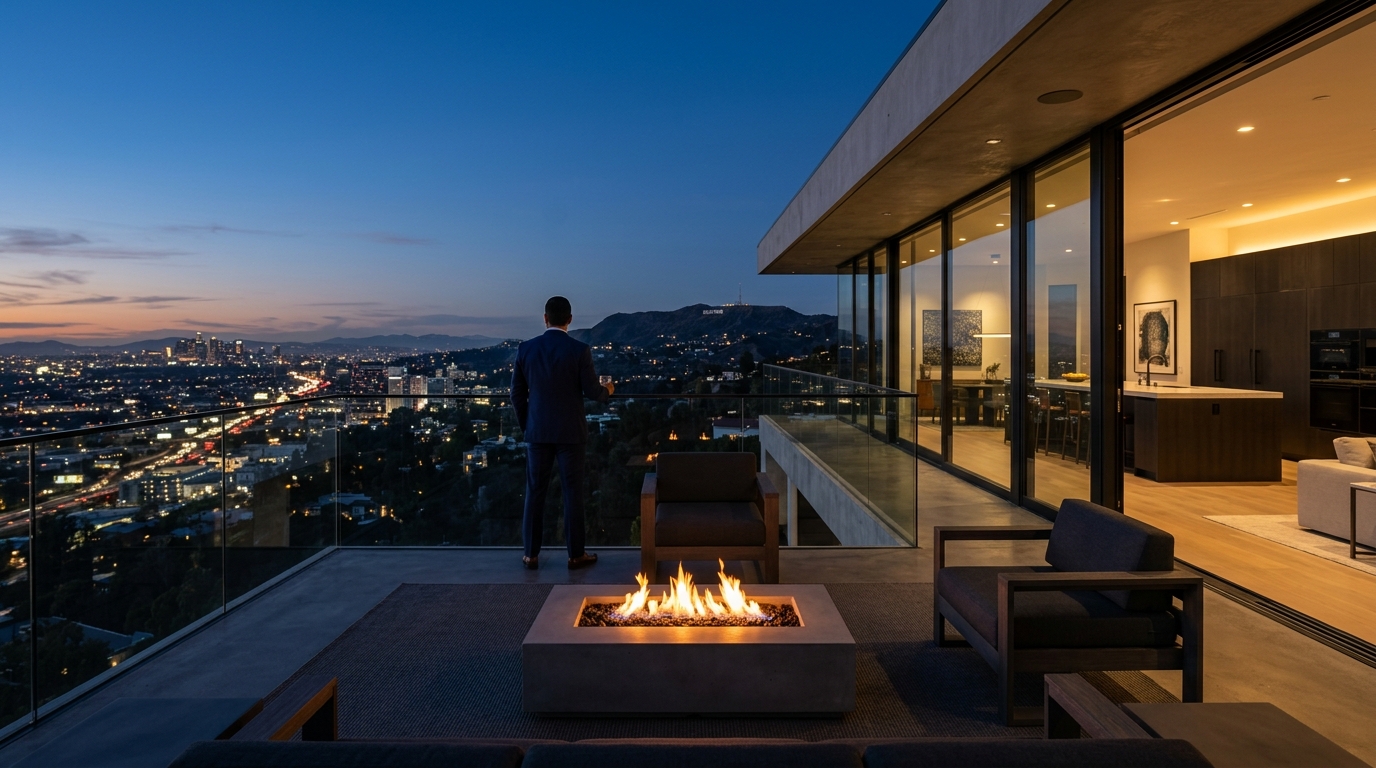
In the upper echelons of the Los Angeles residential market, specifically within the steep topographies of Bel Air, the Hollywood Hills, and the Bird Streets, the term view is often applied with reckless imprecision. For the institutional-grade investor or the sophisticated homeowner, a view is not a static amenity but a depreciable asset subject to the whims of neighboring development and biological growth. The market increasingly distinguishes between a generic vista and a documented, unobstructable view corridor, with the latter commanding a price premium that frequently exceeds 30 percent of the total acquisition cost. Understanding the mechanics of this valuation gap is essential for capital preservation in hillside environments.
The primary threat to any hillside asset is the vertical encroachment of neighboring structures. In high-density luxury enclaves, the height limits dictated by local zoning codes provide a baseline of protection, but they are rarely sufficient to guarantee long-term visual integrity. Sophisticated buyers now look beyond the current horizon to evaluate the underlying development rights of downslope parcels. A vacant lot or a modest mid-century structure situated below a trophy estate represents a latent threat to the property's primary value driver. If a neighbor utilizes their full floor-area ratio and maximum allowable height, a jetliner view can quickly be reduced to a canyon view, fundamentally altering the asset's liquidity and terminal value.
The visual horizon must be treated as a legal easement rather than a mere aesthetic coincidence. To mitigate the risk of encroachment, the most disciplined market participants are increasingly pursuing formal view easements. These are private agreements recorded against the titles of adjacent properties that restrict the height of structures and vegetation in perpetuity. While the acquisition of such an easement requires significant capital outlay and complex negotiations with neighbors, the cost is often reclaimed multiple times over at the point of exit. An estate with a recorded view easement effectively removes the risk of future obstruction, providing a level of certainty that the market rewards with aggressive bidding and shorter days on market.
Beyond structural interference, the management of arboreal growth remains a persistent challenge in maintaining sightline integrity. Many jurisdictions in the West Coast markets have enacted view protection ordinances, but these are often toothless and subject to protracted litigation between neighbors. A sophisticated buyer will conduct a thorough analysis of the local municipal code to determine the specific protections afforded to existing views. In many cases, these ordinances only protect views from certain primary living areas and do not prevent a neighbor from planting fast-growing privacy hedges that can obscure a horizon within a few seasons. The presence of a proactive maintenance agreement or a restrictive covenant regarding landscaping is often the difference between a resilient asset and one that faces a slow, biological erosion of value.
The physical verification of a view's longevity often involves the use of story poles, which are temporary skeletal frameworks used to illustrate the height and mass of a proposed structure. For buyers considering an acquisition near potential development sites, the placement of story poles is a critical due diligence step. It allows the investor to visualize exactly how a future neighbor’s roofline will intersect with their own visual corridor. In the absence of story poles, topographic surveys and three-dimensional digital modeling should be commissioned to simulate the maximum buildable volume of all adjacent parcels. This level of rigor is no longer optional for transactions exceeding the eight-figure threshold: it is a fundamental requirement of modern asset management.
The premium for an unobstructable view also reflects a shift in buyer psychology toward the scarcity of the jetliner perspective. While canyon views offer a sense of intimacy and privacy, the panoramic vista spanning from the San Gabriel Mountains to the Pacific Ocean represents a finite resource. As the available inventory of prime hillside lots reaches a state of total saturation, the only way to acquire such a vista is through the acquisition of existing assets. This scarcity creates a floor for pricing, but only if the view is truly permanent. A view that can be taken away is a view that the market will eventually discount. Consequently, the most valuable properties in the Los Angeles hills are those that occupy a topographical promontory where no downslope neighbor has the legal or physical capacity to interfere with the sightline.
Ultimately, the valuation of a luxury hillside estate is a function of its visual security. Investors who treat the view as a guaranteed component of the real estate are often surprised by the volatility of their asset's value when a neighbor breaks ground. By contrast, those who apply an institutional lens to sightline protection, utilizing legal easements and rigorous topographic analysis, ensure that their property remains at the top of the market’s desirability hierarchy. In the geography of high-net-worth real estate, the horizon is the most valuable square footage a property owns, provided that horizon is legally and physically secured.