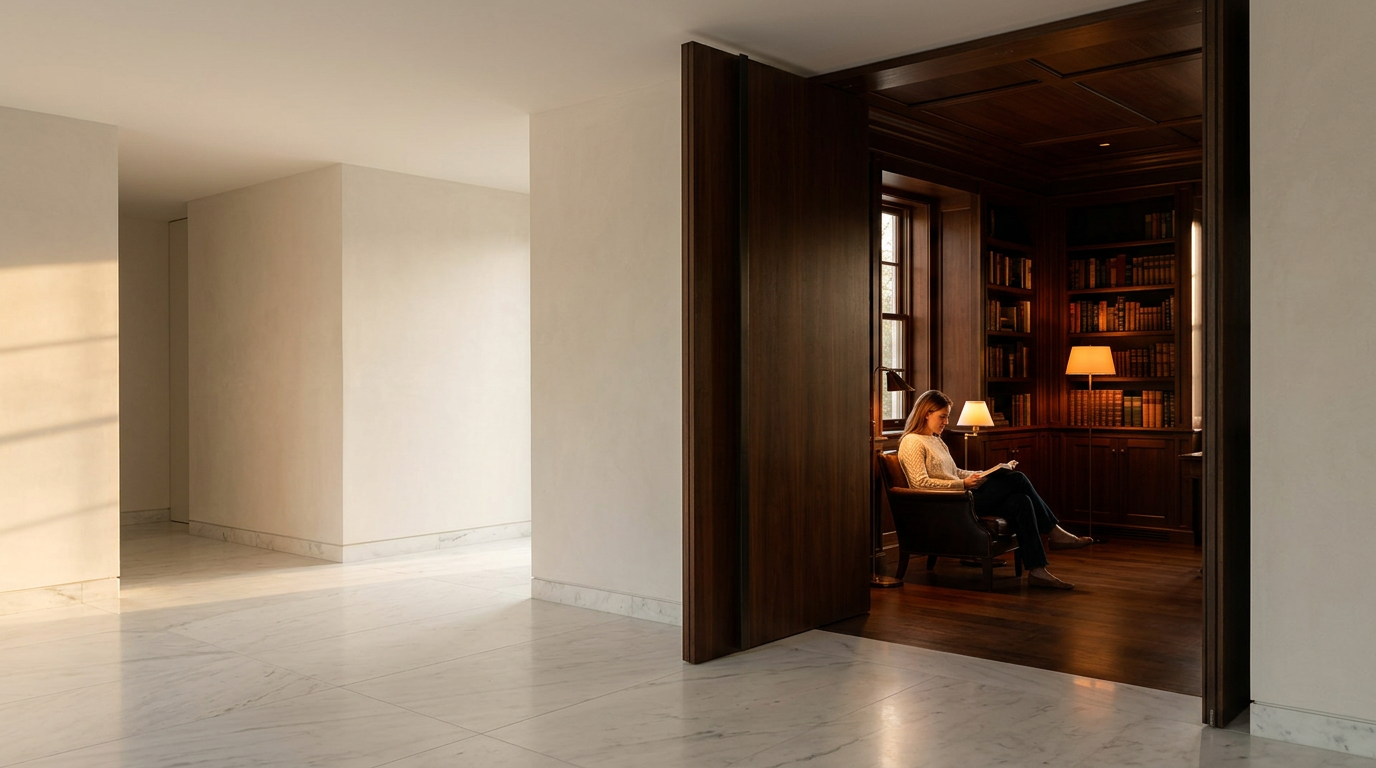
In the upper tier of the luxury market, the architectural discourse often centers on the volume of primary living spaces or the quality of finishes in a chef kitchen. While these elements are necessary prerequisites for a capital-intensive estate, they are ultimately static. The true sophistication of a residence is revealed not in the rooms themselves, but in the passages that connect them. This is the architecture of transition, a discipline that separates high-end production from the rare, enduring masterpieces that define a legacy portfolio.
A transition is never merely a hallway. It is a psychological aperture. When executed with precision, these spaces manage the cadence of a home, orchestrating a narrative shift as a resident moves from the public performance of hosting to the restorative seclusion of the private wing. The most successful estates leverage what can be termed the threshold effect: a calculated modulation of light, acoustic dampening, and material texture that forces the occupant to recalibrate their sensory expectations before entering a new zone of the home.
The compression of space is the primary tool of the master architect. In many contemporary speculative builds, architects prioritize an unrelenting openness, assuming that total transparency equates to value. On the contrary, the most desirable properties utilize deliberate constriction. A gallery passage that narrows in width or lowers in ceiling height before opening into a grand double-height living room serves to amplify the impact of the final destination. This is not a matter of square footage efficiency, but of spatial psychology. By denying the eye a constant vantage point, the architect creates a sense of discovery that keeps the residence feeling fresh and engaging over decades of habitation.
Materiality within these transitional corridors must be distinct from the primary living spaces. Where a living room might feature limestone or expansive glass, a transitional vestibule demands tactile engagement. The use of heavy, tactile materials like rift-sawn white oak, burnished brass, or hand-troweled plaster serves to ground the occupant. These surfaces are meant to be touched, providing a somatic connection to the structure that reminds the inhabitant of the permanence of their surroundings. In a world of increasing digital abstraction, the physical weight of a well-crafted transition provides a necessary anchor for the senses.
Acoustic control is the silent partner of spatial intent. High-end buyers often overlook the sound profile of their homes until they reside in them. A property that allows the cacophony of a social gathering to bleed into the primary suite is a failure of architectural planning, regardless of the quality of its stone or woodwork. Effective transitions act as acoustic buffers. By incorporating massed walls, dual-door entry systems, or even subtle changes in flooring substrates, architects can create a sound-dampened barrier that ensures the private sphere remains inviolate. This is the ultimate luxury: the ability to exist within a singular structure while maintaining absolute sonic autonomy.
Lighting, too, must be decoupled from the standard grid in these transitional zones. While primary rooms rely on task and ambient lighting to facilitate function, transition zones are the ideal canvas for atmospheric, low-level illumination. Subtle wall grazing, recessed foot-level lighting, and the integration of natural light via indirect clerestory windows serve to guide the inhabitant without overwhelming the optic nerve. By lowering the light intensity during the movement between rooms, the architect allows the eyes to rest, effectively resetting the inhabitant for the next environment. It is a rhythmic pulse, a heartbeat of light that brings the residence to life.
Ultimately, the value of a property is determined by how it shapes the life of its occupant. A home that lacks defined transitions is a home that lacks depth. It offers everything at once, leaving nothing to the imagination and providing no sanctuary from its own presence. For the investor or the discerning buyer, the mandate is clear: look for the spaces between. Seek the properties that treat the journey through the house with as much reverence as the destination. True architectural value resides in the sequence of experience, in the deliberate curation of movement, and in the quiet authority of a well-engineered threshold.